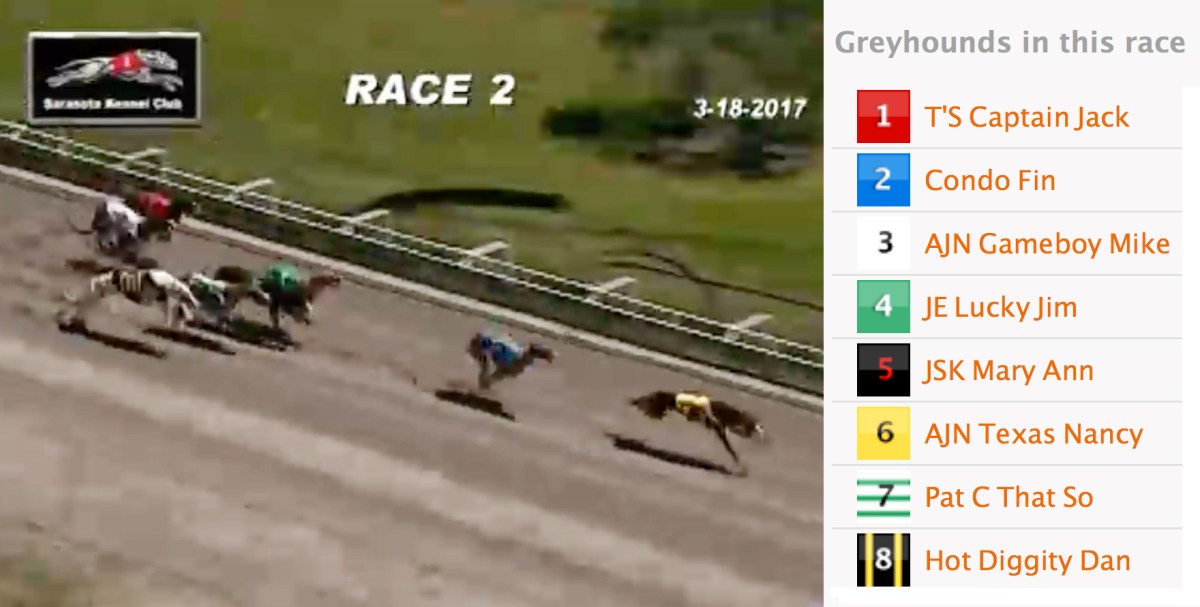
My registered name was AJN* Texas Nancy. I am one of countless racing greyhounds bred to earn money by running as fast as I can.
That’s me up there in the yellow silk, leading the pack in Sarasota, Florida, before I got enough bumps and tangles and injuries to lose my enthusiasm for running.
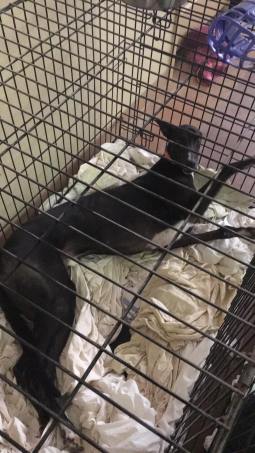
In my seven month career, I raced 41 times on three different tracks in Florida, with three 1st places, six 2nd places, and nine 3rd and 4th places. Not too bad, but nowhere near good enough. My brother Clyde did better, winning frequently for a year (we even raced together a couple times), until he dislocated his wrist so severely, he was removed from racing. Nine months later and he’s still trying to recover… (photo below right).
The most common racetrack injury is a broken toe; however this injury doesn’t typically end our racing career, provided we’re winning enough to justify the expense and down-time for recovery.
The next most common injury is a broken hock, which typically ends our career. “The right hock is usually the one to go,” says greyhound veterinarian Suzanne Stack, “most commonly in the first turn, where the greyhound pushes off with it on the banked curve.”
Outside of racing injuries, we are no longer considered an asset when we’re not placing first, second, or third on a consistent basis. When that happens, it makes no financial sense to keep us (unless we show promise for breeding).
If we’re lucky, we’ll be offered to a rescue group. If we’re very lucky, the rescue group will have space to take us (i.e., kind volunteers willing to bring us into their home as a foster dog). If we’re not lucky, we have a very short life.
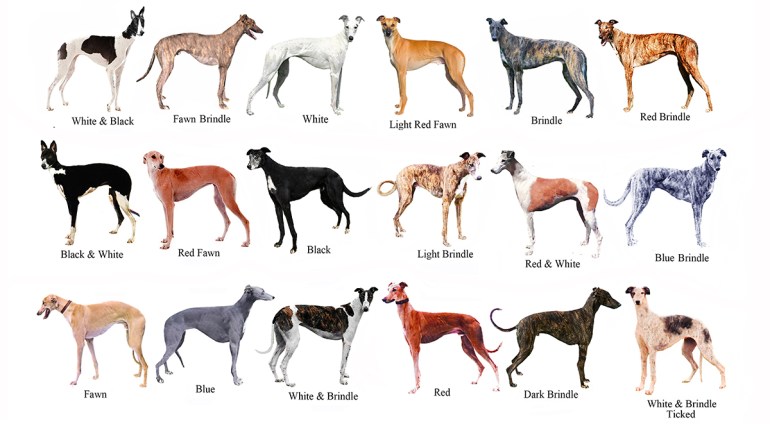
As a black dog, I’ve often heard that we’re overlooked in favor of other more “exciting” colors. It’s true… we come in just about every dog color you can imagine, including black, white, a variety of brindle colors, fawn), and red.
Some of us are spotted like a cow (with black, tan, grey, or brindle spots), some of us have “ticking” (lots of fur freckles), and a few of us have small white “dots” all over our black fur as though we raced through a field of snowflakes. Yes, we also come in “grey” (aka “blue”).
Despite all these colors, we are not bred for looks; there is no American Kennel Club (AKC) judging us on the color of our fur, the size of our head, or whether we have the proper skin folds or tail length or movement.
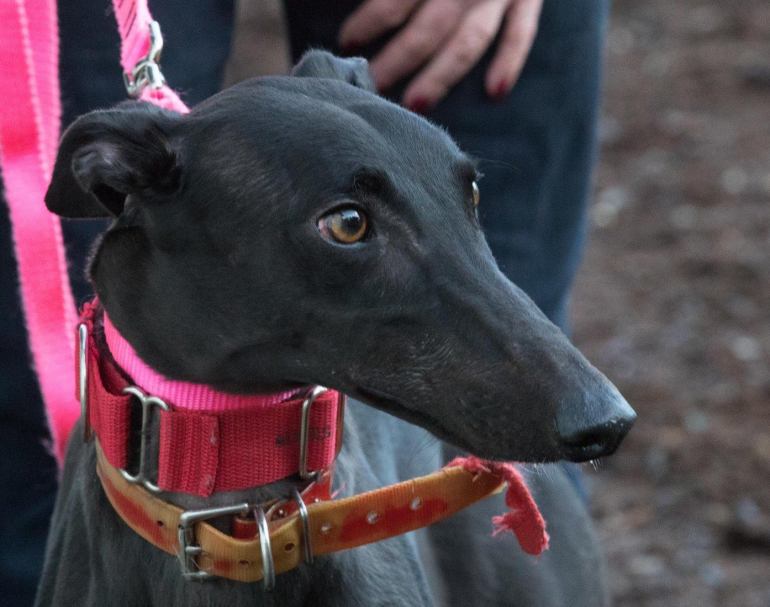
“What track am I at now?” (I’ve no idea that I’ve arrived at a rescue kennel)
Instead we are bred to be physically sound, reliably fast, and “biddable”—willing to do what’s asked of us, willing to let trainers and others handle us often, without resistance or complaint.
There’s no such thing as hip dysplasia in a greyhound. We don’t need a cesarean section to deliver our pups. We typically live 12 to 14 healthy years or longer.
Best of all, because we typically remain with our original pack for a year or more, we are socialized well beyond the average puppy. We know good dog manners… our pack makes sure of it.
Somewhere between 15 and 18 months of age, we’re taken to our first racetrack; in my case this was Sarasota, Florida. It was here that I met Hazel, my trainer, who began preparing me for racing, and oversaw my 7 month career.
“She just wasn’t one to run fast enough,” said Hazel, “we were at a speed track, and with her short legs [she] just couldn’t keep up. She pulled a muscle and I didn’t want to take the chance of hurting her. So I sent her to the adoption.”
While some of us might be transferred to another track, most of us are finished raising within 3 to 6 months.
In late September 2017, I was put in a transport vehicle and driven to a kennel in Colorado. It looked sort of similar to the racetrack kennels I’d lived at for the past year, but it was much colder than my home state of Florida, and there wasn’t a racetrack anywhere in sight.
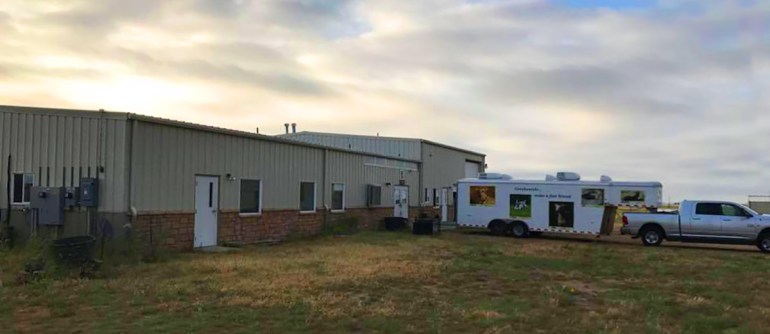
Photo of Almost Home for Hounds by Sandy Hightower
I had no idea this was the first step in a whole new life: Almost Home for Hounds is a greyhound rescue “halfway house,” run by an incredibly dedicated veterinarian named Heather Weir.
While in Dr. Weir’s care, I received all my shots, was spayed, had a full dental, and something a little more unusual: my lower canine teeth were “shortened” because I have a very prominent overbite, and those two teeth were poking into the roof of my mouth. You can’t imagine how much easier it was to eat, after that…
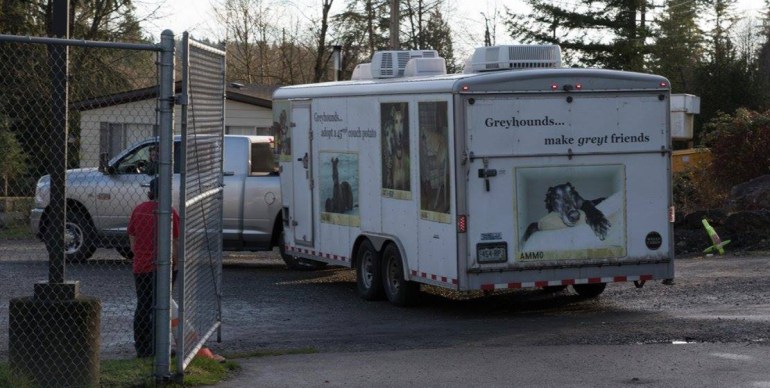
Once she has a sufficient number of greyhounds “vetted and ready,” Dr. Weir loads us into her greyhound transport trailer, and drives to various greyhound rescue groups in Oregon, Washington, and sometimes British Columbia. I was earmarked for Greyhound Pets, Inc. in Woodinville, Washington (a little ways outside of Seattle). I arrived in January 2018.
Not long after I arrived, I had a new trainer, or so I thought: this “trainer” wasn’t interested in how fast I could run, but in how well I could sit! Her name was Nanz, and thanks to her patience and kindness, I learned how to sit and began experiencing my first official walks on leash. In grass! Smelling mountains and trees!
One day a man came to take my photo for the website. I had no idea that photo would be the passport to a life beyond anything I could imagine…
—
*AJN is the name of the greyhound breeding and training kennel located in the Florida panhandle, where I was born and raised.
 Jasmine The Greyt